How Dapr Handles Event-Driven Architecture (And Why It Matters More Than You Think)
How Dapr Handles Event-Driven Architecture (And Why It Matters More Than You Think)
Introduction: Event-Driven Architecture Is Powerful and Painful
Event-Driven Architecture (EDA) is often described as the natural evolution of modern distributed systems. As applications grow, synchronous request–response patterns start to strain: services block each other, deployments become risky, and scaling one capability often requires scaling everything.
Events promise relief. Services can react to change instead of coordinating around it. Producers and consumers evolve independently. Systems become more resilient to partial failure.
But anyone who has operated an event-driven system in production knows the other side of the story.
Message brokers come with steep learning curves. Each service embeds broker-specific SDKs. Retry logic is implemented differently everywhere. Observability is fragmented across libraries and teams. Over time, the system is technically event-driven but operationally fragile.
This is where Dapr (Distributed Application Runtime) comes in. Dapr is a portable, event-driven runtime that simplifies building resilient microservices by abstracting common infrastructure concerns—like messaging, state management, and service invocation—behind a set of uniform APIs. At its core, Dapr helps developers build distributed systems without needing to become infrastructure experts.
Its core idea is simple but opinionated: application developers should not have to manage messaging internals just to publish or consume events.
This article explores how Dapr approaches event-driven architecture, how it differs from traditional designs, and why its constraints are often a strength rather than a limitation.
Dapr’s Core Opinion: Infrastructure Should Not Leak Into Application Code
Dapr is explicit about one architectural boundary: infrastructure concerns do not belong in business logic.
In many systems, services become tightly coupled to messaging infrastructure without anyone planning it. Broker connection details, authentication, serialization formats, retry semantics and delivery guarantees slowly creep into application code. Once that happens, changing a broker or even upgrading it becomes risky and expensive.
Dapr deliberately breaks this pattern using a sidecar architecture.
Each application runs alongside a local Dapr sidecar. The application talks to the sidecar over HTTP or gRPC. The sidecar is responsible for all communication with external systems such as message brokers.
This design is not just about convenience. It enforces separation of concerns:
- Application code focuses on business behavior
- Dapr handles messaging protocols, retries, authentication and resiliency
- Infrastructure choices are expressed through configuration not code
Dapr accepts a small runtime dependency in exchange for long-term architectural flexibility.
Event-Driven Architecture Through Dapr’s Lens
Dapr treats event-driven architecture as a communication discipline, not merely a messaging problem.
In a Dapr based system, events are treated as facts things that have already happened not as remote procedure calls in disguise. This distinction matters. When services publish events instead of invoking workflows, they avoid implicit behavioral dependencies on consumers.
This aligns naturally with domain-driven design:
- Each service owns its state
- Events describe state changes
- Other services react according to their own domain needs
Dapr does not enforce domain modeling, but its pub/sub API nudges teams toward healthier event semantics by keeping interactions simple and declarative.
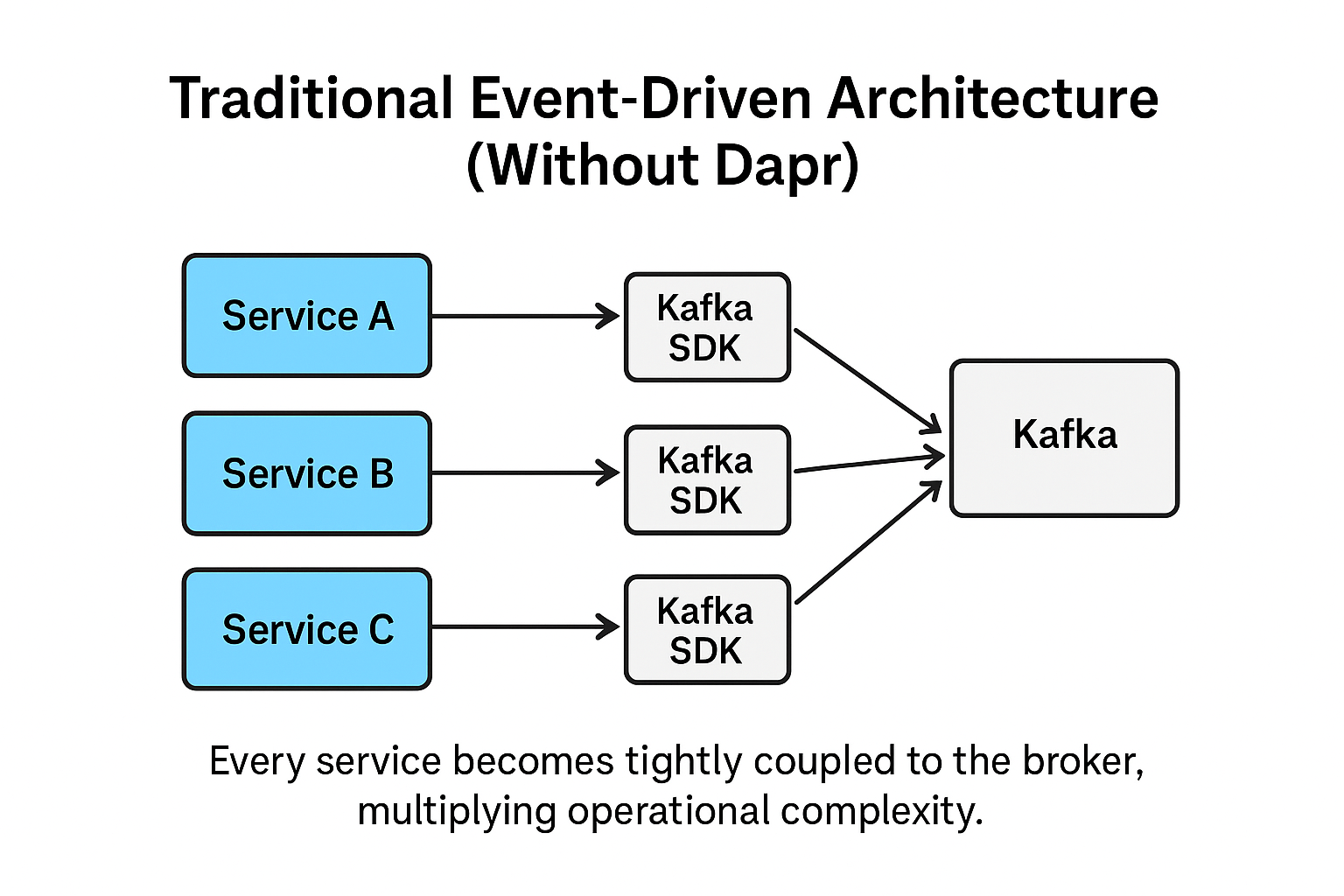
Event-Driven Architecture Without Dapr
In a traditional event-driven setup:
- Each service integrates directly with the broker
- Every service embeds a broker-specific SDK
- Retry, backoff and error handling are implemented repeatedly
Conceptually:
Service A → Kafka SDK → Kafka
Service B → Kafka SDK → Kafka
Service C → Kafka SDK → Kafka
Each service becomes partially responsible for infrastructure behavior. Operational complexity grows linearly with the number of services and mistakes multiply just as fast.
Key takeaway: broker coupling is duplicated across the entire system.
The Pub/Sub Abstraction: A Necessary Layer, Not an Overhead
Dapr’s pub/sub building block provides a stable, broker agnostic API for publishing and subscribing to events.
Applications interact with Dapr using a simple model:
- Publish an event to a topic
- Subscribe to a topic via a declarative definition
Behind the scenes, Dapr integrates with supported brokers such as Kafka, Azure Service Bus, AWS SNS/SQS, Redis and others.
For most business services, direct access to broker internals partitions, offsets or delivery mechanics adds little value. What it adds is cognitive load and long-term maintenance cost.
Dapr moves that complexity to configuration, where it belongs. Teams can change brokers, adjust reliability settings or tune behavior without rewriting application code.
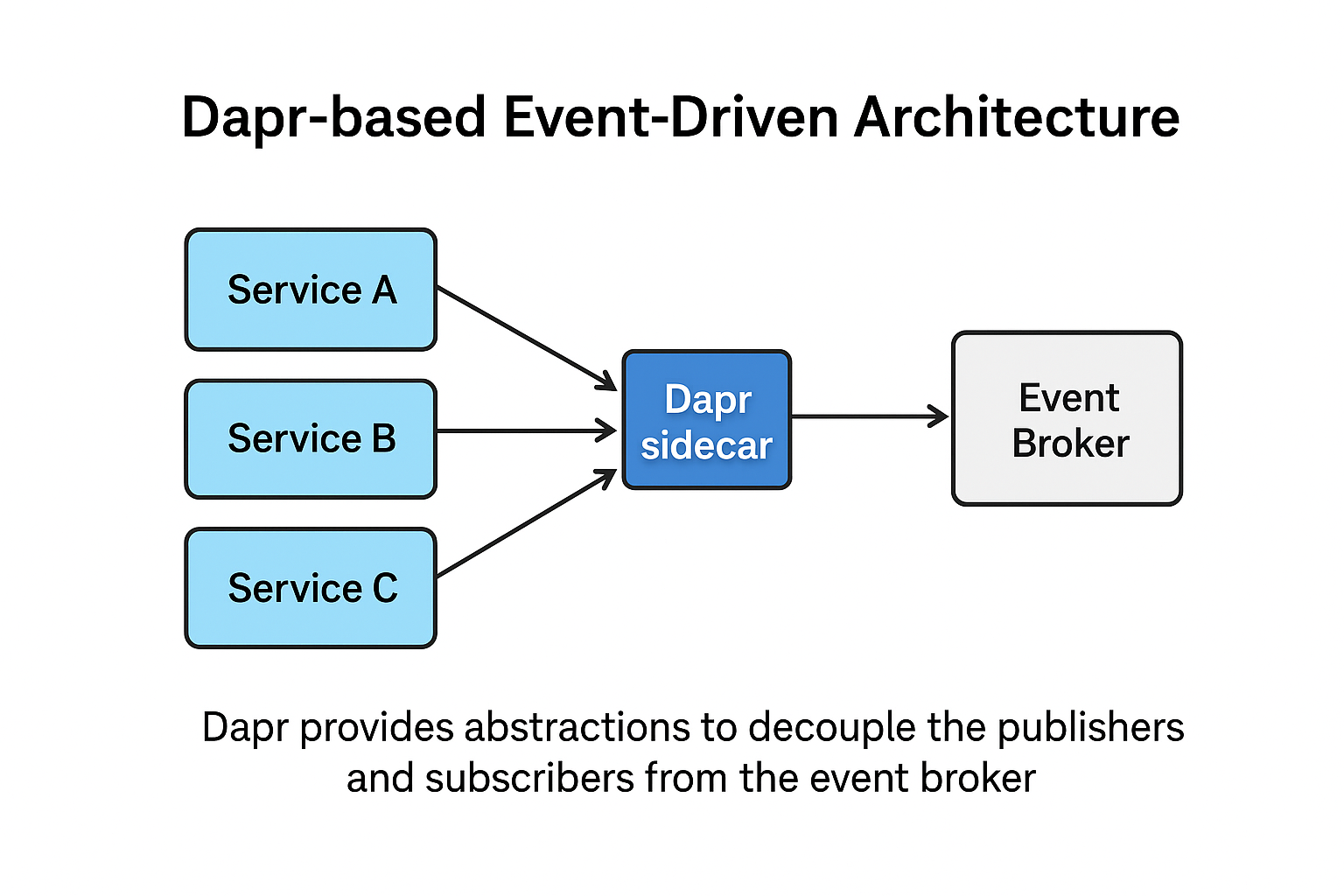
Event-Driven Architecture With Dapr Sidecars
With Dapr, the architecture changes subtly but significantly:
Service A ↔ Dapr Sidecar ↔ Broker
Service B ↔ Dapr Sidecar ↔ Broker
Service C ↔ Dapr Sidecar ↔ Broker
Applications only communicate with their local sidecar. The sidecar handles protocol translation, retries, authentication and observability.
Key takeaway: infrastructure complexity is centralized in Dapr, not duplicated across services.
Event Flow: Boring by Design
One of Dapr’s strengths is how intentionally unremarkable its event flow is.
A typical flow looks like this:
- A business action occurs in a service
- The service publishes an event to its local Dapr sidecar
- Dapr adds metadata and tracing information
- The broker persists and routes the event
- The subscriber’s Dapr sidecar receives the event
- The event is delivered to the subscriber service

There are no hidden callbacks, no custom consumer loops and no offset management in application code. This predictability matters. Distributed systems are already hard to debug Dapr avoids adding surprise behavior.
Boring systems scale better because they are understandable.
Declarative Subscriptions: Making Architecture Visible
Imperative subscription logic often disappears into codebases, making it difficult to answer simple questions:
- Who consumes this event?
- Why does this service depend on that topic?
Dapr addresses this with declarative subscriptions. Subscriptions are defined explicitly (via YAML or programmatically), describing:
- The topic
- The pub/sub component
- The route in the application
This makes event flows visible, reviewable and auditable. Architectural changes become explicit decisions rather than incidental code edits.
Reliability: Designed In, Not Remembered
Dapr makes clear, opinionated choices around reliability.
At-Least-Once Delivery
Dapr’s pub/sub guarantees at-least-once delivery. Duplicate events are possible, but silent data loss is not. This is a deliberate trade-off aligned with production realities.
Built-In Retries
Retries are automatic and configurable. Developers do not need to remember to implement retry logic or implement it differently in every service.
Dead Letter Topics
When events repeatedly fail delivery, Dapr can route them to a dead letter topic. This acknowledges a hard truth: some failures require human intervention.
Dapr assumes failure is normal and designs for it explicitly.
CloudEvents: Standards Over Reinvention
Dapr uses the CloudEvents specification for event metadata. This provides consistent structure for:
- Event identity
- Source and type
- Tracing and correlation
Standardization pays off quickly. Events become portable, tooling works consistently and observability is no longer an afterthought.
Advanced Capabilities Without Advanced APIs
Dapr supports features such as:
- Message filtering
- Bulk subscriptions
- Scoped components
- Transactional outbox-style patterns (depending on broker support)
Crucially, these capabilities are exposed through consistent APIs and configuration not through increasingly complex client libraries.
Advanced systems do not require advanced APIs. They require predictable ones.
Where Dapr Shines and Where It Doesn’t
Dapr is particularly well-suited for:
- Microservices owned by multiple teams
- Event-driven workflows
- Polyglot systems
- Cloud-native platforms
It may be less ideal when:
- Every service requires deep broker-specific tuning
- You are building a low-level messaging platform itself
Dapr is opinionated and that is precisely its strength.
Conclusion: Dapr Is a Constraint, and That’s a Feature
Dapr does not eliminate the inherent complexity of distributed systems. What it does is move that complexity to the right place.
By abstracting infrastructure, standardizing communication and providing safe defaults. Dapr turns event-driven architecture from an expert only craft into a repeatable engineering practice.
In a world where distributed systems are unavoidable, Dapr’s most important contribution is not just technology it is judgment.
And for teams building systems meant to last, that judgment matters more than it first appears.